Alex Lewis Spotlight
It all started at the ripe age of three: senior painting major Alex Lewis recalled his destined career as an artist beginning after watching cartoons, but instead of following them all the way through, he’d pause them to sketch the frame.
Lewis’ mother saw his talent right away, telling him he was going to be an artist after seeing his youthful cartoon sketches — Lewis’ response to this was a simple, “Yes, I am,” — and he never stopped drawing.
“I would copy down anything I saw, any pretty faces, any things from TV that I really liked,” Lewis said. “My art was never really about myself. It was always depicting someone else and being realistic. I was just getting my foundations.”
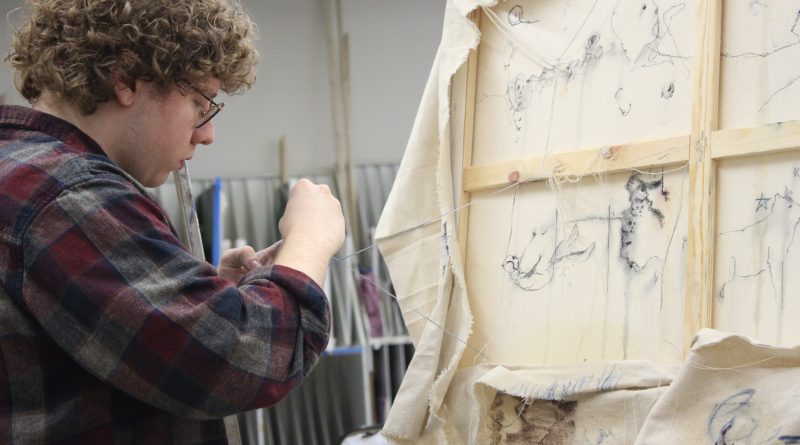
Lewis tends to create pieces that are a mixture of automatic drawing and expressionist quality. He said he began to venture into abstraction during his sophomore year when he took Intermediate Drawing Exploration 1 with Professor Laura Naioti. Lewis said she inspired him to navigate abstractions.
“I found [my style] through the difficulty I had in oil painting here,” Lewis said. “You start out with oil paint, and it’s hard to render and it is very exhausting. It eventually got nauseating — because I have scoliosis so that kind of repetitive movement where you’re working on a painting for eight or 12 hours at some point it just stopped working for me. That’s why soft pastels kind of called to me like two years ago. It’s so much more immediate, I can get a painting done in one-fourth of the time while still expressing myself to the fullest that I can.”
Lewis sees his art as an emotional outlet, and while Lewis doesn’t typically go into a piece with a plan, he ends up drawing something similar either to what he feels at the moment or a premonition to what he may feel or experience in the future.
He plans to continue creating art in the future and making it his entire career. He’s hoping that after graduation, he’ll get his name out there and people will be interested in his art more often.
“I don’t feel like there’s any other job I could do both from a skills standpoint and an emotional one.,” Lewis said. “I just wouldn’t be fulfilled doing pretty much anything else. Luckily, my mom has been so supportive about me making art ever since I was a young kid. She hasn’t ever pushed onto the fear of ‘How are you gonna make money?’ like that’s never been part of our conversations, it’s always been ‘What do you want to do?’ So I feel insanely lucky to be in the position I’m in and I’m just gonna keep pushing through it.”
To make ends meet while pursuing his art career, Lewis said that he plans to update his website and post on social media to find people interested in buying his art. Lewis said that he doesn’t enjoy commissions, as there are too many expectations and he wouldn’t have the freedom to express himself through his art, but that he would continue to put his art into shows.
“I’m relatively anti-institutions to some degree —where they wouldn’t be able to interact with my paintings because they aren’t allowed to touch the art,” Lewis said. “I want people to be able to interact with my paintings, I want them to be able to look and peel up pieces of my painting to see if they could find messages or something. I think involving the viewer makes my work more meaningful because it’s less about me.”
- When you encounter an art block, how do you overcome it?
- Art block is a state of mind, i do get art block sometimes but i’m not sure how to answer that
- What is it like to do this on top of your regular classes?
- It makes a lot of my regular classes feel unimportant sometimes. Like it’s not as engaging for me, but it also inspires me sometimes. Although for the past two years I’ve only been taking art classes or courses that pertain to art. Like, even art history is insanely helpful for my painting practices. But the STEM credits I took felt like something I just had to do to get through. Although the anxiety from the STEM credits were kind of a hindrance to me because I would feel like I was failing if I got like a B and it got really bad at one point.
- Describe your art evolution
- I started just taking clips of shows I liked and trying to depict them faithfully on paper. Then that shifted to portraiture because I tried to draw people I loved in my life often. I remember being like, 8 and trying to draw my sister accurately– looking back it was garbage but I remember being so excited because I thought it looked just like her and it was literally just like a potato. It took a long time to decide like ‘i actually want to make art for the long run’ because it’s all about complimenting people say ‘oh that looks just like this thing’ or ‘you nailed that’ and then you have the people that are like ‘i can’t even draw a stick figure’ like that specific phrase haunts me because of how many times people have said that. But i started making my own images somewhere in highschool, but not too often because I was more into copying things down and getting that technique—I was also using mostly charcoal at the time and then that carried over into freshman year where I had a whole account dedicated to it I think it was charcoal.alex and it was only charcoal portraits of people I saw on TV or faces I remembered well. I have to give a shoutout to Aaron Fine because I took a painting class with him—it was my first one— and the idea that I had to have an artist statement was shocking to me. The fact that I had to have a reason behind the image, that was totally foreign to me. But I started with religious works, unpacking the madness of religion, but my works started shifting at some point to more and more about me and that’s kind of where I am now. I’m making these images that are expressing these interior sort of unseen truths.