
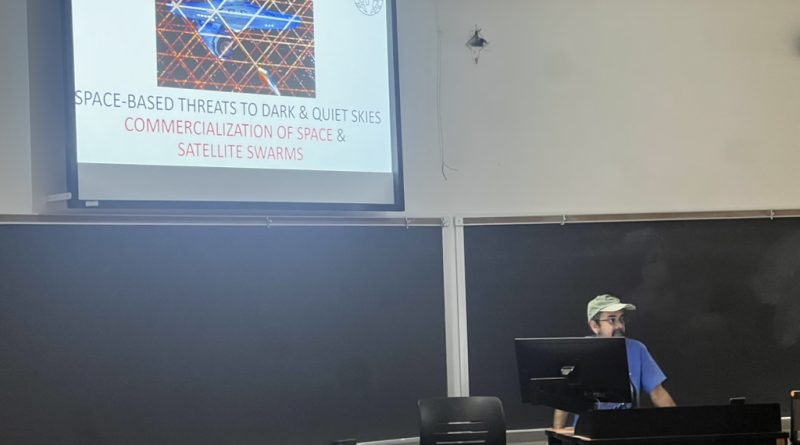
Astronomer warns the public about satellite swarms
Light pollution and satellite swarms have become an increasingly significant problem over time, spiking in 2019 and continuing to rise even today. Truman State University physics professor Vaujeet Gokhale has kept note of these issues as he is an astronomer. Gokhale has been a professor at the University for 17 years and has a few projects in the works to prevent light pollution on campus, including installing new lights for the paths at night that are motion sensored and downward facing. Gokhale held a lecture on Oct. 23 to inform the public of these issues, as well as methods to help decrease light pollution.
Light pollution negatively impacts human circadian rhythm, bird and sea turtle migration and astronomy research. It also increases greenhouse emissions and wastes precious natural resources. Satellite swarms, which are large sums of satellites grouped together in our atmosphere, are much more negative and dangerous. Gokhale said in his lecture that there are roughly 14,000 satellites orbiting Earth. Nearly 10,000 of these satellites are owned by SpaceX, which started launching satellites in 2019 and they plan to launch at least 20,000 more.
“The sheer number of these satellites and the potential detrimental effects of putting these chemical elements into the somewhat fragile upper atmosphere when we do not know what that will do, we need to do research first before we do something like this,” Gokhale said. “So the rate at which we are doing this without really knowing what could be the effects of it during launch, while the satellites are actually up there, when they burn up while they fall. I think it needs further inspections and public attention to force these entities to tell us more information about what’s going on up there so we can decide whether we want to let this happen to our upper atmosphere or not.”
Satellite swarms are increasingly becoming a bigger problem. SpaceX, an American company, launches batches of 60 satellites into low Earth orbit every few days. These satellites and the ones launched by other countries and private companies reflect the light from the sun back to Earth, getting the odd streaks visible to the naked eye.
There are five main problems with the increasing number of satellites in orbit: light pollution from the sheer number of them, space debris, atmospheric pollution, chemical pollution during and around launches, radio interference, and the weaponization of space.
“I had no idea about the problem with satellites and just how many there were up in the sky and the problems that they are causing,” freshman JJ Regueiro said.“[It’s] ridiculous that SpaceX is planning to launch 30,000 satellites. We don’t need all of this, and it’s slowly just eating away at our planet.”
Other students from the lecture shared a similar sentiment about the problems being caused by companies like SpaceX.
Ways for individuals to prevent light pollution include turning off the lights when they aren’t needed, getting downward-facing lights instead of lights that point to the sky, and using motion sensor lights or lights with a timer to avoid overconsumption.
When it comes to the satellite problems, Gokhale said it is best to contact your local representative, whether that be the House or Senate, and discuss the issue with them. If they get enough requests to bring the topic to the surface, they may be more likely to do something about it.
“It’s one of those things where being informed is worthy in itself,” Gokhale said. “That sets you up to the next stage of ‘Is this good?’ or ‘Am I indifferent to it?’ or ‘This is terrible [and] we need to do something about it. You’re in a position to make that decision, which you can’t unless you know what’s going on.”
Many of the people who attended the lecture had no prior knowledge of these global issues, and a few had slight knowledge of or about the topic. These people who attended the lecture also think that these satellite swarms and the problem of light pollution are becoming increasingly problematic, and something needs to be done about it.