McNair program keeps its funding after a brief scare
Truman State University’s McNair program will continue to receive its funds from the United States Government after a two week period of fear that the Trump administration would end the program. The McNair program is a part of the trio that empowers low-income and first-generation college students.
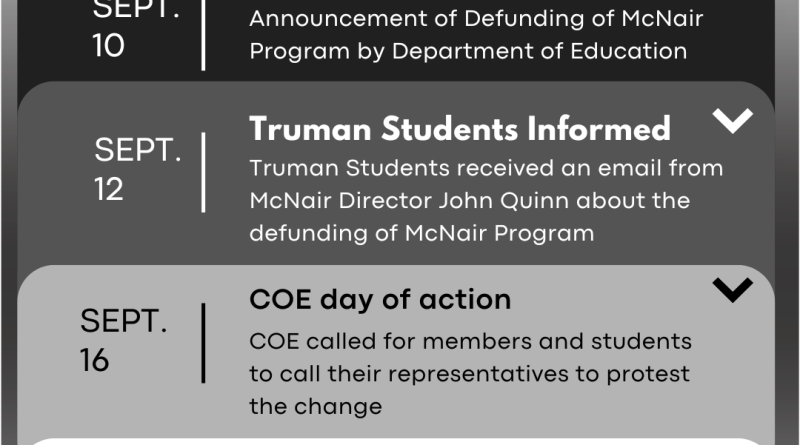
During a Council for Opportunity in Education, the McNair program directors were informed by the Deputy Assistant Secretary for Higher Education Programs, Christopher J. McCaghren, that the McNair program did not align with President Trump’s stance on Diversity, Equity and Inclusion and would have its funding cut. The University’s McNair program is set to receive $300,000 per year for the next five years.
Director of the McNair program John Quinn was at the conference and said it was uncharted territory for the president not to execute the funding approved by Congress. The COE was concerned that this might be an issue, but after the notice from McCarghren, the COE decided to take direct action, as the McNair program helps many low-income and first-generation students.
“For first-generation, low-income students who get into college, once they’re in one of our programs, they’re four times more likely to graduate and 10 times more likely to go to grad school,” Quinn said.
Quinn, along with members of the COE, called their federal representatives Sept. 16 during a day of action to protest the claimed defunding of the McNair program. Since Quinn could not use government funds to lobby the government, he made the call during his private time calling his senator and congressional representative.
The University’s McNair program typically had around 30 students per year, one of those students being junior Jada Ray. Ray said she couldn’t believe the government would cut a program that had helped her and so many other students across the country, but felt the change would not mean the end for the McNair program.
“McNair isn’t just about funding,” Ray said. “It’s a program for low-income, first-generation, underrepresented students who, despite the odds, push forward. Struggle isn’t new to us. This was just another obstacle we learned to overcome, and we did.”
Ray said she heard from Quinn that the program would keep its funding Sept. 22. She hopes that the McNair program can continue to withstand political agendas that wish to see it gone.
The McNair program had 90% of the original funding reinstated after the protests of members of the COE and students, with the other 10% being classified as “too DEI.” Quinn said the McNair program requires that two-thirds of the members are low-income or first-generation students, regardless of race or sex.
Quinn said that the importance of the program comes from its ability to give students opportunities to succeed that they would not have otherwise. McNair is currently looking for students who are first-generation and low-income, and looking to pursue a research master’s degree.