A Campus and Community Divide: Hidden Homelessness in Kirksville
Out of the 17,841 members of the Kirksville population, 8,000 are students at Truman State University or A.T. Still University, according to the 2025 local census. The school surrounds the city, and according to sophomore math major Nathan Keever, the school is the lifeblood of the community; therefore, it is our responsibility as students to give back and serve.
Homelessness is an issue that goes unseen in smaller, rural communities like Kirksville. The community’s focus on the University results in a blind spot for issues surrounding homelessness and the need for low-income housing. Enda Whitlock, Community Service Block Grant (CSGB) director for the Community Action Partnership of Northeast Missouri (CAPNEMO), believes those blinders have grown more pronounced over the past five to six years.
“One of the biggest challenges surrounding homelessness here is visibility,” Whitlock said. “Kirksville does not have a traditional emergency homeless shelter, and unhoused individuals may be staying temporarily with friends, living in vehicles or cycling through unstable housing. The issue can be easy to overlook. Homelessness doesn’t always look the way it is portrayed in larger cities.”
The CAPNEMO has a mission to assist and empower individuals, families and communities to achieve their greatest potential. Whitlock has been involved with the organization since her daughter attended the Head Start program and eventually accepted the role in the Low Income Energy Assistance Program. Growing up in the Kirksville community, Whitlock has a keen eye on the community atmosphere and has seen firsthand the ways in which people view it through selective glasses – choosing to live under the impression that Kirksville simply doesn’t have homelessness.
“People don’t want to see it, or they think that if they see someone struggling, they can just send them to an agency like ours, and we can fix it,” Whitlock said. “That’s not how it works – it takes a lot more collaboration.”
Keever reflects upon the hidden issue of homelessness in relation to his involvement in Blue Key, a service-oriented organization on campus. Keever believes the happenings of the town are very contained to the campus. He found that it wasn’t until he began volunteering in the community that he began to feel the areas of neglected need within the city.
Limited housing in the Kirksville area can be linked to the University’s major involvement in the town. A large amount of rental housing is targeted for Truman and ATSU students due to the fact that the majority of people looking for rentals are students. Whitlock emphasizes the effect this has on affordable housing, as rental agencies have narrowed their view of renters to a primarily student-based demographic.
“People who are homeless might run into the issue of not being able to repair their credit score and end up stuck in a bad cycle of being judged by their credit score alone,” Whitlock said. “They might have a good rental history but be hit with a bump in the road that keeps them from finding a new place to rent. They shouldn’t always be judged by that. The person might have a bad credit score, but they can pay for their rent, and they have good references.”
The divide between the Kirksville community and Truman State’s campus is an easy gap to mend in Whitlock’s eyes. Education is at the heart of this repair. Housing insecurity looks different from city to city. Even if that city is as close to Kirksville as Columbia, the issue will present itself differently. Whitlock believes learning about where there are soft spots within the community and spreading awareness of these issues are small steps that can make a huge difference.
Blue Key and other service organizations on campus are a prime example of how students can give back to the community, and Keever is an example of the reason students should get involved. Being involved in the community allows Keever to become more aware of what is going on outside his own life and foster an outward community.
“It’s fulfilling for yourself, but it’s also important to give back to the community that puts so much into the school,” Keever said. “Because the community surrounds the college, it is important to push students to go out and serve it.
Whitlock encourages students to learn more about the Kirksville community to understand the ways in which they might help serve those in need. CAPNEMO is more than happy to have an open discussion with any person or group of interested people.
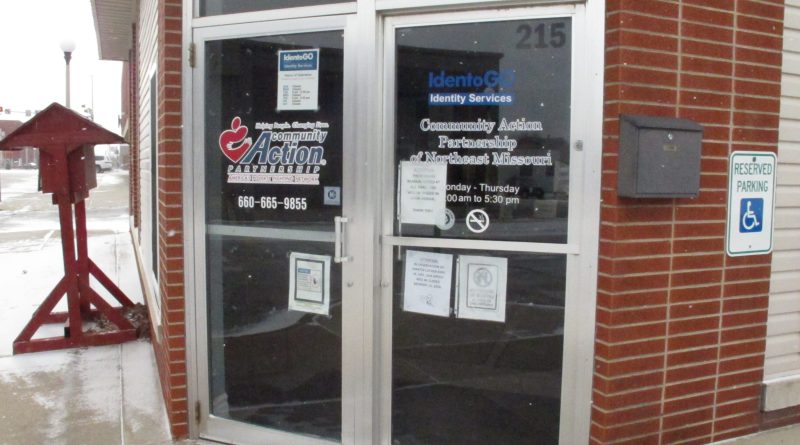
Contact CAPNEMO via telephone at 660-665-9855 or visit their offices Monday-Thursday, 8:00 a.m.-5:30 p.m., located at 215 N. Elson St., Kirksville, MO.