Accessibility remains an issue for students and faculty
Despite Truman State University’s efforts to improve life for students and faculty facing accessibility issues, many still face troubles and want their concerns addressed.
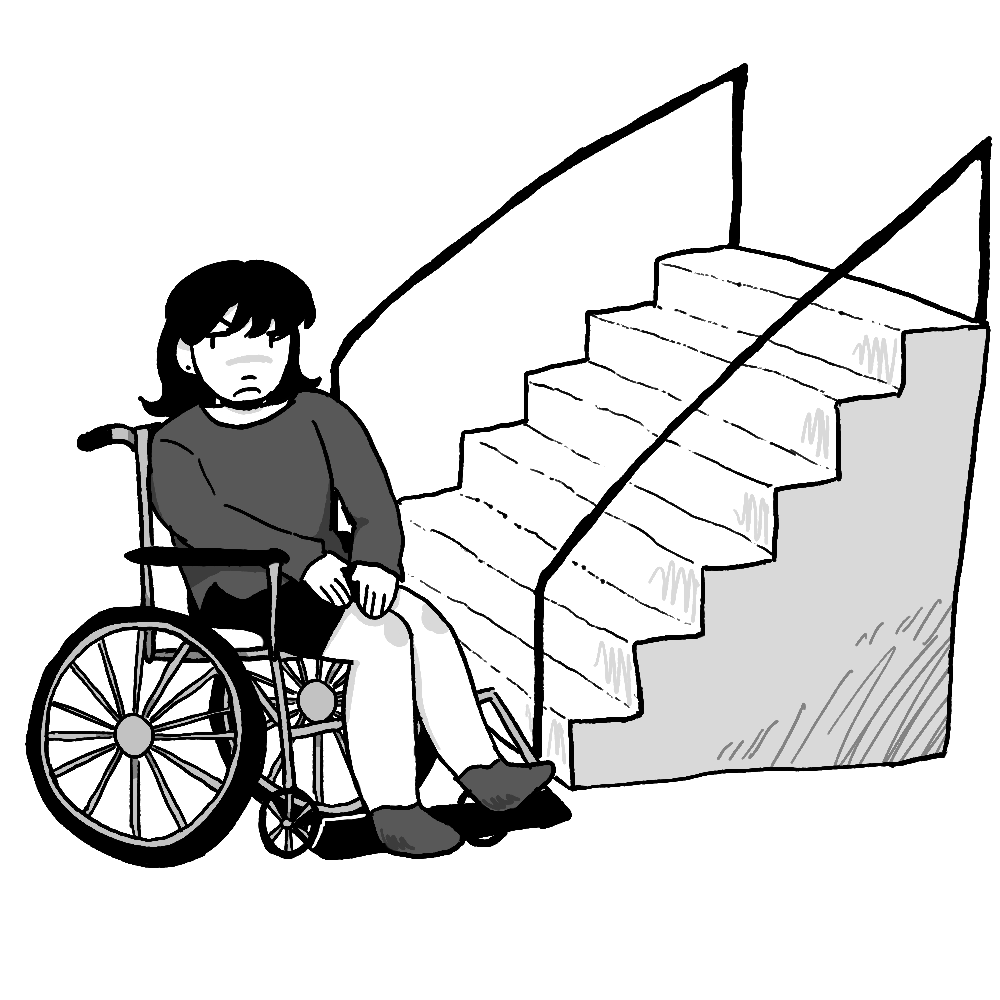
“On the opposite side of McClain, there is a handicap accessible door. You wanna know what’s on the other side of those doors? Stairs,” freshman B Wiley said.
Wiley is not a permanently disabled student. She was in a wheelchair for several weeks following a surgery for a torn ACL and meniscus, and was on crutches for months after to avoid putting too much weight on her bad leg.
Wiley, regardless, expressed the frustration as a wheelchair user on campus.
“It’s definitely been an inconvenience,” Wiley said. “I’m not permanently disabled, so I know what it’s like normally. I have that better understanding of accessibility. But it’s definitely inconvenient, it’s a lot easier to walk around normally.”
Wiley didn’t plan on needing accommodations or vetting college campuses for accessibility. The unexpected nature of needing accommodation is one of many reasons accessibility should be of high importance to any student body.
Disabled students planning for college still experience this frustration.
Freshman Suba Carpenter uses a cane due to a limb length difference in his legs. This causes chronic pain and difficulty walking long distances or up stairs.
Sources like the U.S. News College Compass led Carpenter to believe the University’s campus was highly accessible. Despite this, Carpenter has been frustrated with his experiences in getting around.
“It’s unfortunate that in order to get around, I have to go five different ways to get anywhere, when the average person only has to do one.” Carpenter said.
Carpenter has noticed that the nature of many buildings give him a difficult choice ― walking longer or taking the stairs. Neither are conducive to his wellness, as both can cause him pain.
Stephanie Russell, instructor of history, agrees with Wiley. She is involved with the disability studies minor and teaches two courses on disability.
“I don’t want to make it sound like Truman is at the bottom of the barrel of accessibility, but there are significant barriers to access at Truman,” Russell said.
Her words were not all criticism, but they encouraged more thought to be put into the choices made on the University’s campus.
“I think that there’s a real problem having the [Student] Access and Disability Services on the third floor of Kirk,” Russell said. “There is an elevator, but the elevator signage is not prominent and the elevator is actually not wide enough at the doorway on the first floor to get in particularly wide mobility devices. A gurney would not fit through there, which is also a problem looking at this being a health center. For instance, a student who might only be temporarily using a wheelchair, but has to have their leg extended … she would have a lot of trouble navigating that elevator.”
Given Kirk is one of the more recently established on campus, problems like these run deep.
Another building on campus, McClain Hall, was criticized by students with disabilities.
“In order to get from my second class of the day to my third class of the day, I have to traverse from Violette Hall to Baldwin Hall.” Carpenter said, “Which for an able-bodied person is doable in the ten minute passing period but I walk slower and I can’t walk up stairs well, so I have to take the elevator. Because of the architecture of Baldwin Hall, the elevator from the front forward entrance is in the back right corner of the Baldwin building. Which is very frustrating.”
Using elevators and walking across campus is often taken for granted by able-bodied students, but something as simple as an out-of-order elevator can make students like Carpenter late or miss classes entirely.
Unfortunately, peers are an added complication rather than a solution for the issue. Carpenter said even though he has good days where he doesn’t use his cane, he will often bring it anyway so people will allow him into elevators.
“It’s also obnoxious that I have to use elevators, and just regular people use them. I cannot use the stairs, I have no other option,” Wiley said. “I think it’s out of ignorance though, I don’t think it’s intentional.”
The University works with what it has. While refusing a direct interview, the Title IX office encourages students — abled or disabled — to come to the office to discuss access issues, or to any point of authority that is most comfortable. Title IX also encourages students to obtain accommodation through the Student Access and Disability services, located in the Kirk Building.
Communication, however, is another obstacle to gaining access. Something is not considered truly ‘accessible’ unless it can be used by disabled persons without assistance. But in the meantime, asking for assistance is a task often relegated to students with disabilities.
“When you are a person that is discriminated against to some degree, you want to be careful about who you choose to talk to and who you don’t choose to talk to,” Carpenter said.”
Freshman Sophia Mueller has a similar story. Mueller uses arm crutches as a result of her Ehlers-Danlos, a hypermobility syndrome that results in chronic pain and frequent dislocation of joints
She has advocated for herself in her residence – but did select between totally accessible housing and pet housing.
“I likely would [talk to the title IX officer] if I had any serious issues, but I do think that my experience in Kansas was just so bad that I don’t see myself in practice doing it. It’s certainly nothing against him, it’s just I’m thankful for what I’ve got,” Mueller said.
While Mueller speaks on the limitations of asking for help, Wiley had a different perspective. She suffers from anxiety, which makes asking for help difficult. Social disorders and worries like these can make a disabled experience much harder.
It’s not all bad news. Russell said, while not accessible, the University is not the worst a campus can be. Mueller, while touring other schools in Kansas, had much more difficulties getting around, and spoke positively about selecting a dorm building and the assistance and freedom it provided.
Wiley, who had to adapt on the fly, was grateful for a supportive hall director. Both Wiley and Carpenter said their professors were willing to adapt for their unique needs.
“Truman is a fun place and I really appreciate that out of all of the issues with accessibility there has been an effort to include people who need extra access,” Carpenter said. “I heavily hold the opinion that just because someone is disabled doesn’t mean they should have to stay home.”