Stargazers and DarkSky provide opportunities for outdoor leisure
Throughout the year, DarkSky and Stargazers organize activities for students to step away from outside distractions and take a moment to just breathe. While Stargazers is a Truman State University-specific club, DarkSky has many chapters internationally. However, they share a common goal – to get people to enjoy and relax in the outdoors.
For DarkSky, this goal is accomplished primarily through organizing stargazing events. For Truman’s chapter specifically, these events – called star parties – are held at Thousand Hills State Park, the Truman State Observatory and other miscellaneous locations in Kirksville.
“We have star parties here but many state parks have stargazing or other nighttime events where they look at fireflies for example, some state parks or conservation areas have bats, so they do night walks [or] night hikes to see them,” Vayujeet Gokhale, board member of DarkSky Missouri, said.
Although both organizations aim to get people outdoors, another major goal of DarkSky is to raise awareness of light pollution and how it affects both humans and animals. Humans are especially impacted by viewing blue light at night.
The University has attempted to implement changes to lighting to campus, and a big part of that is due to Gokhale and Colin DeGraf. He has been a professor of physical sciences at Truman for six years.
“We want to avoid unnecessary light pollution,” DeGraf said. “As we’ve walked around [campus], people will provide feedback on what lighting they liked, what lighting they didn’t, and the reasons why. That helps people get a direct, hands-on chance to see [that] there is a definite difference.”
Gokhale is also the advisor to Stargazers. He was hired in 2011 as an astronomy professor at the University. Gokhale was assumed the Stargazers’ advisor, as the previous astronomy professor, Matt Beaky, ran it as well.
Stargazers have two parts of their meetings. Every Monday at 5:30 p.m. they meet in Magruder Hall in room 1099, then go to the University Farm around 30 minutes after sunset.
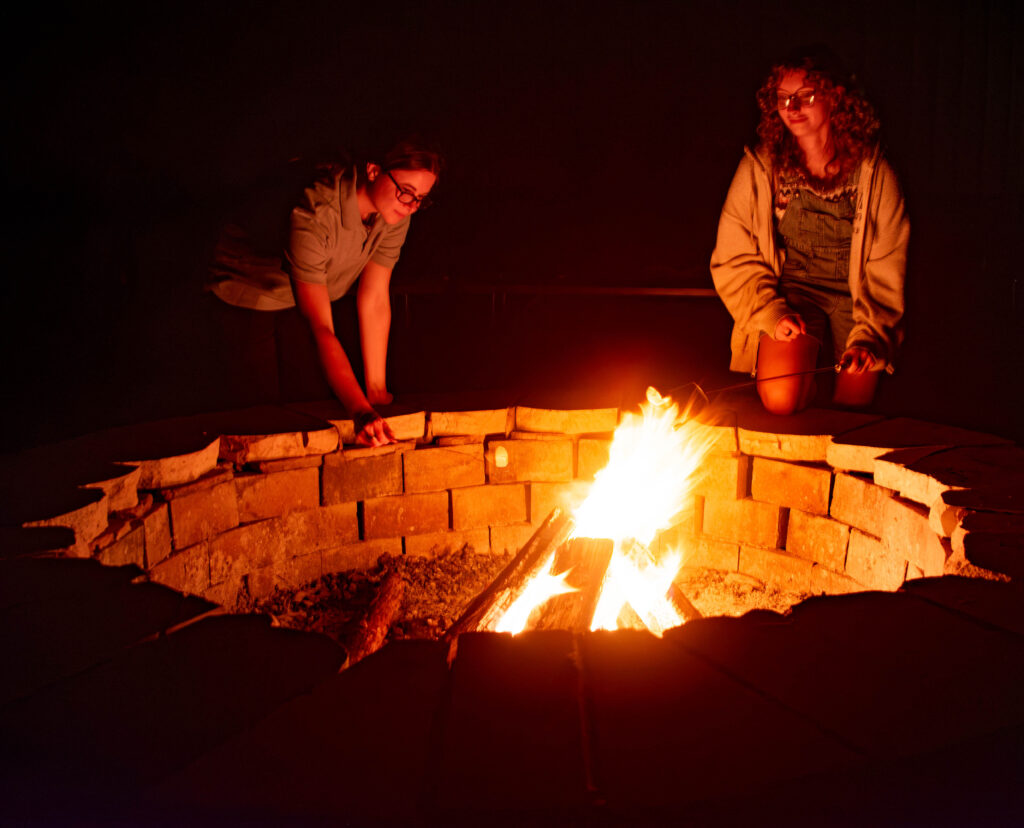
For the beginning of each year, and more recently each semester, it has been tradition for Stargazers to host a bonfire to show people who may be interested in observing the constellations and seeing what they do at the club. They had s’mores roasting and storytelling going on about the stars.
“The bonfire was fantastic,” Junior Parker Shelly said. “I got to hang out with so many people I rarely see, which was really nice. We even got to do a star tour and talk about all the constellations, and the red moon. It was a great night, I always have such a fun time in that club.”
The 10 executives of Stargazers plan out the information and activities at the weekly meetings. They talk about the sky forecast, space news, mini lessons about astronomy, pictures of the day and games relating to anything from the constellations to the spacecraft.
“I like talking to everybody, it’s always really fun,” junior PR manager Liz Winham said. “I really enjoyed being the presenter and kind of being the person running the ‘star tour,’ because I’ve been putting a lot of effort into that, so it’s very very nice for it to pay off.”
At the stargazing later in the evenings Winham typically uses her laser to point up at the sky while the risk manager, senior Liberty Murphy, talks of folklore to the masses.
Gokhale hopes that stargazing will encourage people to spend more time outdoors at night and relax by getting lost in their thoughts.
“How many kids climb trees?” Gokhale said. “How many adults climb trees? How many adults just sit there under a tree and read a book? To me the reconnection [with] nature is the most important aspect of what we should all be trying to do.”