
Faculty and students takes measures to prevent hazing
The University has a low number of hazing reports, with only two public incidents in 2025. Faculty members and student organizations take measures to prevent hazing on campus.
Director of Citizenship and Conduct Zac Burden said the University is required to maintain a listing of hazing cases on their website for five years. The federal law states campus websites need to be updated twice a year unless there have been no findings. Burden said his office decided to update the website directly after each incident instead.
The most recent cases, one for Delta Zeta and one for Sigma Phi Epsilon, occurred in April 2025.
The compliance website said Delta Zeta’s incident occurred during a scavenger hunt. According to the website, “The scavenger hunt list included actions calling for new members to violate local public indecency laws and to participate in sexualized dancing at fraternity houses with fellow Delta Zeta members.”
Sigma Phi Epsilon’s report included cleaning up after parties, designing and carrying bricks and carolling to sororities on campus.
Both cases violated three sections of Truman’s code of conduct. The University’s
Institutional Compliance Officer and Title IX Coordinator, JD Smiser, becomes involved in hazing cases that are discriminatory or sexual in nature.
“My focus on that is going to be the victims,” Smiser said. “The impact of parties, the person or people who had to do something they didn’t want to do that was sexual in nature, whether that be a type of forced nudity or other acts of discrimination”
After the instances, both organizations had to participate in extra training for hazing prevention as part of probation. Sigma Phi Epsilon is still on probation until June 30, 2027.
The Department of Public Safety reports hazing in their crime logs. DPS updated these reports July 23, 2026 with three reports of hazing.
Two of which were for the same incidents filed on the Stop Campus Hazing Act compliance information website. Burden said there are different requirements for the reports.
“Even if I did an investigation and found that no hazing occurred, the federal law for what the police have to report requires that they include that in their statistics,” Burden said.
Burden said he reports hazing incidents to DPS immediately after completing hearings. Burden said hazing is one of the few cases that doesn’t go through DPS first.
“The handful of hazing investigations I’ve done have been rather small in nature based off of both how long it took to investigate it, but also the nature of the offense was relatively small,” Burden said.
Both Smiser and Burden said a lot of hazing cases can grow from an organization’s traditions or alumni. Burden said students may not report hazing if they are afraid of being kicked out of the organization they want to join.
“It takes courage to come forward as a member of the organization to showcase this,” Burden said. “It even takes courage from somebody who’s outside the organization to share that.”
Burden said he hopes there aren’t a lot of reports because hazing isn’t happening at Truman.
Senior Natalie Whipple said Sigma Kappa has a strict hazing policy due to the U&I’s involvement, but she said hazing doesn’t exist in any of her other organizations either. Whipple is Sigma Kappa’s risk manager, while also the recruitment chair for Alpha Sigma Gamma and a member of Delta Sigma Pi.
“I know all schools are like ‘we don’t haze,’ but so many schools get away with it,” Whipple said. “Truman does not at all.”
The code of conduct lists specific sanctions for hazing. These include warning, probation, suspension and expulsion or non-recognition.
“Organizations found responsible for hazing could suffer some pretty big reputational loss when recruitment for student organizations is as competitive as it is, having a hazing transparency report can muddy that,” Burden said.
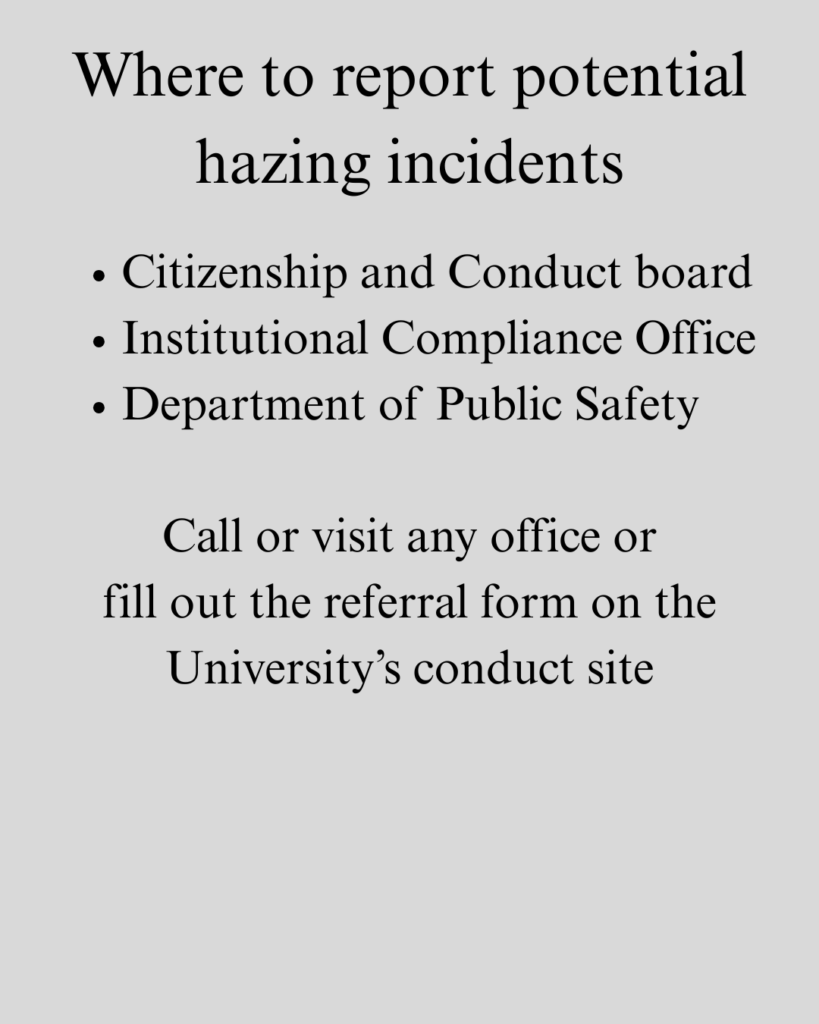
Burden said students can report instances by calling his office, visiting him in person or using a behavioral referral form on the conduct website.
Burden said reports can be anonymous but that not having a contact point may hinder the ability to move forward.
“I want someone, if they feel like they’ve been hazed that is sexual or discriminatory in nature, that this is a place that they can come to directly in a safe environment that’s confidential, and they get to take the lead and control what happens because that’s what’s important to them,” Smiser said.
Whipple, who handles the code of conduct for Sigma Kappa, said she tries to ensure members are comfortable communicating concerns with her as soon as bid-day. Whipple said she told new members to reach out even if they weren’t sure if actions are hazing because it is not tolerated at all.
Smiser said people could avoid making reports because they don’t have trust in the system or because Smiser and Burden have been proactive in preventing hazing. Burden said he pushes the idea that hazing is abuse.
“I don’t get reports where I think people are intentionally trying to haze people,” Smiser said.